The First Visit in 16 Months—and What Happens When a Parent Is Erased
Updated: May 1
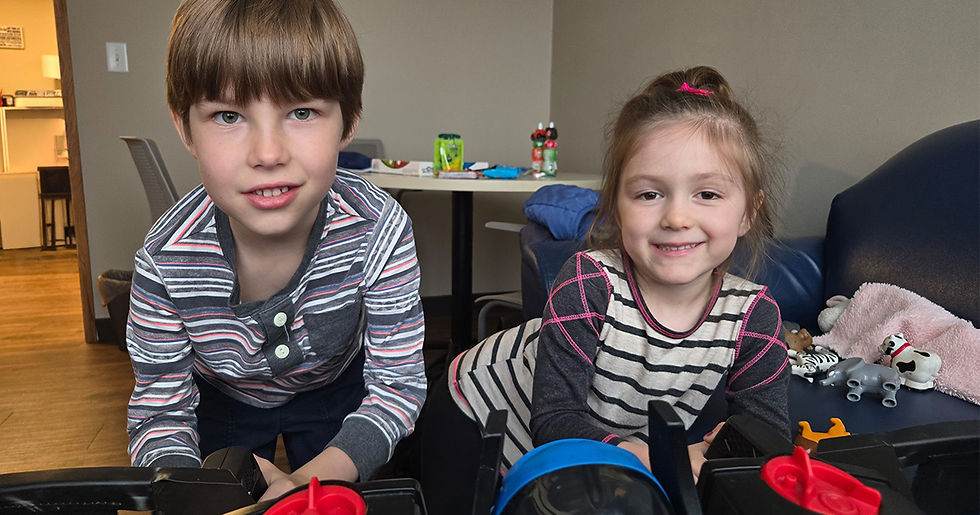
Today was the first day in 16 months that I saw my children.
You might wonder why—after all this time—this is happening now.
The answer is actually simple.
Just a couple of weeks ago, I had a motion in front of the court requesting temporary custody of my children. This is my second request. Alongside that, I also have a motion for sanctions against opposing counsel for intentional obstruction of my parenting time.
Under Minnesota law, the violations alone could justify a transfer of custody. Whether the court will follow the law is something we will soon find out.
On top of that, our trial begins in just over five weeks—the final decision point for custody.
So yes, suddenly there is cooperation.
But let’s be clear: this isn’t accountability—it’s optics.
For 16 months, neither their mother nor her attorney followed the court’s orders. Not one. And this all started 22 months ago, when my children were taken from me based on false allegations—allegations I proved false in court in 2024.
Despite being found to be a fit parent in an October 23, 2024 court order, I still do not have my children.
So Today Was Supposed to Be a Good Day
I knew it wouldn’t be.
I’ve seen this before.
I had five visits under similar conditions in December 2024 and early January 2025. Those visits were difficult—and they are fully documented on my website. They are now part of my federal civil rights lawsuit against the State of Minnesota and twenty-six other defendants.
What I witnessed then—and again today—is something many people don’t understand:
Parental Alienation
This is not just conflict between parents.
This is coercive control.
What many call 'conflict' is often actually Parental Alienation, a form of coercive control. This occurs when one parent conditions a child to fear or reject the other parent through manipulation and emotional pressure.
Under Minnesota Statute § 260E.03, this is recognized as a form of maltreatment. The law defines 'Mental Injury' as a substantial impairment to a child’s emotional stability. When a child is pressured to erase a parent from their life, it isn't just a 'family issue'—it is substantial child endangerment as recognized by our state’s protection and custody laws.
Yet in Minnesota, despite laws that should address it, it is largely ignored.
Because of that, it has become normalized.
And worse—it has become generational.
Children raised in this environment often repeat the same patterns as adults. I’ve seen this firsthand, as their mother was raised this way, and I’ve seen how it affects adults through her behavior on our children. It becomes a learned behavior. A family cycle.
Mental Health: The Issue No One Actually Addresses
We hear constantly that mental health is one of the biggest concerns in our state.
Legislators talk about it in nearly every committee and floor session.
But that’s all we do—talk.
There is no meaningful effort to address root causes. Instead, we react after damage is done.
In family court, this failure is amplified:
Courts rely on testimony without evaluating mental health realities
Behavior rooted in instability is treated as credible evidence
The system reinforces harm instead of preventing it
And many of the people who have the power to fix this system… don’t.
Many are attorneys themselves.
So ask yourself a simple question:
Why would a system built on conflict want to eliminate conflict?
If families were healed, court involvement would decrease.
If court involvement decreased, so would revenue.
If you think that sounds far-fetched, I’m open to hearing a better explanation of why, as a society, we’ve allowed this behavior to continue and influence courtroom rulings for decades.
The Visit
The visit went as well as it could.
At first, the kids were scared of me.
They wanted to cry.
So I gave them space.
They are being told things about me that simply aren’t true. Meanwhile, every documented record shows the opposite—that their mother was the one acting abusively, the one removed by law enforcement, the one who admitted to her actions in recorded statements.
But these kids don't know this and there's no way they could understand right now.
They operate on what they’re told.
A Moment That Says Everything
At one point, I brought snacks and drinks.
They clearly wanted them.
The staff even told them it was okay.
But my youngest looked to her older sibling—and he shook his head “no.”
So she didn’t take it.
Think about that.
A child needing permission—from another child—because of fear of what might happen later, something I witnessed firsthand in prior visits when normal behavior—like sitting on my lap and playing with me—would be reported back to their mother and then completely stop in the next visit.
That’s how parental alienation reflects in a child’s behavior toward the other parent—driven by fear of their custodial parent, who is the actual abuser.
Then Something Shifted
Slowly, they began to open up.
We played the board game Trouble. It was my first time playing, but they knew it well—and they taught me.
My youngest, just four years old, surprised me. She wasn’t just playing—she was thinking ahead, using strategy, choosing moves that gave her advantages.
By the end:
She won
Her brother came in second
I lost
And we were laughing.
We gave high fives.
But Even That Comes With a Cost
I won’t share everything that happened during the visit.
Not because it wouldn’t help people understand—but because it could be used against my children.
That’s the reality.
Anything they say or do can—and likely will—be reported back and corrected before the next visit.
I’ve seen it happen already:
They sit with me → next visit, they don’t
They hug → next visit, they won’t
They engage → next visit, they withdraw
This is what alienation does.
It forces children into a position where they feel they must choose sides just to feel safe.
And eventually, many of them do—not because of the truth, but through manipulation. They learn to side with the parent they spend the most time with, the one who controls their daily life; as a child, the truth doesn’t matter—repercussions do.
They’re Only 6 and 4
Let that sink in.
Six and four years old—and already being conditioned to fear their own father.
Already learning to suppress natural affection.
Already being taught that love comes with consequences.
There may still be time to undo this.
But every week this continues, that window gets smaller.
And at some point, it closes.
I know this because I’m working with so many mothers and fathers who have lost relationships with their children.
The System Behind It
This visit took place at a supervised visitation center—but before it even started, I was reminded of something that should concern everyone.
I was told I could not record the interaction.
Let that sink in.
A system that claims its purpose is to protect children is actively preventing a parent from documenting what happens to those children.
And this isn’t theoretical.
Prior visits—at a different facility—were recorded, and those recordings showed clear signs of distress and harm. Not assumptions. Not opinions. Evidence.
So instead of allowing transparency… it was removed.
That raises a much bigger question than policy or procedure:
Why would a system designed to protect children limit accountability?
Because when you remove the ability to document, you remove the ability to prove.
And when you remove the ability to prove, you control the narrative.
So the real question isn’t just what is gained.
It’s this:
What are they afraid will be seen?
Because this isn’t isolated—this is becoming more common across these types of facilities, and that says something.
It’s why I’m planning to include this in our reform initiative: a legal parent should have the right to document potential child abuse of their own children—especially in controlled environments where that may be the only opportunity to do so.
This isn’t complicated. This isn’t controversial.
It’s accountability.
And it should be one of the easiest bills to introduce.
The Reality
I wasn’t an absent father. Not even close.
I was with them every day.
Working from home, raising my kids, taking them to parks, beaches, hikes, riding bikes—living life with them, not just around them.
There are messages to prove it. Their mother saying she wished she could be there with us, wishing she had what we had in those moments.
There were nights we’d sit on the floor with both kids on my lap—playing—while she didn’t have one, something that even became a point of tension, because she would say they liked me more and I’d try to balance it by reminding her they asked about her during the day.
That was our reality.
So no—the kids I once had now act very differently toward me. The affection they had for me as their father has been erased.
Looking Forward
At the end of the visit, they didn’t want to hug me.
But they let me help them with their jackets.
We gave more high fives.
Small steps.
I hope next week is better. I know parts of it will be, but I also know some of what happened today will regress. I’m aware that writing this doesn’t help that—because I know it’s being read—but the reality is the visitation center’s notes are shared with all parties anyway. There’s no way around that. This is the process. And this is how our children end up carrying the weight of it.
But Ask Yourself This
Is this really how we should be handling families?
Where years go by with a parent removed from their child’s life, damage building quietly in the background, and by the time anything is corrected—if it ever is—you’re left trying to rebuild something that never should have been broken in the first place.
Right now in Minnesota, this is how we handle family court. This is what we as a society have decided represents the best interests of our children. And until we change the system, this is exactly what will continue.
We Can Do Better
We have to do better.
Because this isn’t rare.
This isn’t an exception.
And every day this continues, more time is taken from families that they will never get back.
And every day this continues, our children are being shaped by trauma they never should have had to carry.
Because every day for a child is their whole life.
And eventually, there is a breaking point—where there is no going back. The damage is done, and for some families, it becomes too late.
I’ll see you at the ballot box in November—because this doesn’t change unless we change it.
🔁 Join the Fight for Reform
I have filed a federal civil rights lawsuit challenging systemic misconduct by judges, attorneys, and state agencies that has stripped parents of their rights and traumatized countless children.
With 27 defendants, including the State of Minnesota, this case seeks accountability — and reform.
Join me in taking this mission national.
How You Can Help:
✅ Join the Coalition: Minnesota Family Rights Coalition
✅ Sign the Petition: Reform Minnesota’s Family Court System
✅ Sign the Petition: Urge DOJ to investigate family-court violations
✅ Subscribe: Stay updated — Contact
✅ Visit: www.ryanalvar.com
✅ Follow & Share: Real Dad Initiative
✅ Contact Your Legislators: Demand oversight for Judges, GALs and transparency in family court.
Family-court reform won’t happen unless lawmakers hear directly from the people.
If what you’ve read here troubles you, don’t stop at signing the petition—call and email your state legislators. Tell them that what has happened in this case—and in so many others—proves we need oversight for judges and guardians ad litem, uniform due-process protections, and full transparency in family courts.
📬 Not sure who represents you?
💬 Not sure what to say?
I made it easy.
👉 Start here: 🔗 Legislation
Across the country, I’ve heard from parents who’ve lost everything—many haven’t seen their children in years. When the system designed to protect families becomes the weapon that destroys them, it’s time for change. We must fix this broken family court system. Until that day, I’ll keep fighting—for our children, for truth, and for justice.
"667 days since my children were kidnapped. This isn't over."
Ryan William Alvar
Parent and Plaintiff
#theduluthmodel #FamilyCourtReform #falseallegations #mentalhealthmatters #RealDadInitiative #StopParentalAlienation #VoicesOfAlienatedKids


Comments